Sunday, October 24, 2010

Pretty Pokhara

Here are some images from my recent trip to Pokhara (200 km west of KTM):


The view from the World Peace Pagoda overlooking Pokhara.

Not the most confidence inspiring sight to see dozens of sunken boats by the shore.

The mayhem surrounding the boat launch on Phewa Lake.

The island on Phewa Lake.

A boy standing near a shrine on the island.


There were many people on the island.

Holy men near Barahi Temple on the island.

Some men hanging out 30 km South of Pokhara with Mt. Macchapucchre looming in the background.


A beautiful camping spot.

Paragliders flying over Pokhara.

Saturday, October 9, 2010

What a Week. Now with Photos!

After driving about 30 minutes outside of Kathmandu and in a state of mild carsickness I dropped off my bags at my new homestay family’s home and made the short 3-minute walk to the Siddhimangal School, my teaching home in Siddhipur for the next 9 months. My week then started off with a bang.

I was greeted at the school gate by my counterpart teacher (Dwaraka) and led into the central courtyard. I was then confronted with the most overwhelming, over the top, and charming welcoming ceremony I have ever experienced. As I was processed down the center of the courtyard, on my left sat a hundred or more primary school students spelling out ‘welcome’ with their bodies and on my right was another hundred or so students all offering me colorful flowers. My hands were quickly overflowing with the ridiculous amount of flowers and my face brimming over with smiles. I made my way into one of the classrooms and was joined by most of the 20 or so other teachers and a group of grade 8 students. After many speeches in English, Nepali, and Engali (some sort of mixture of English, Nepali, Hindi, andNewari) I was serenaded by fun and lively Nepali songs. I made a short speech (in Engali) and Dwaraka and I headed off to teach some English classes.

Siddhimangal students.

Students scream for their desired bingo numbers at a program ushering in the Dashain festival.

Dwaraka is in his mid thirties, tall, skinny, and has a stylish blonde whiff of hair above his right brow. He is amazingly friendly, speaks good English, and has so far been a fantastic mentor at school. He has provided me with some entertaining moments as well. During our first class together he introduced me as an American and proceeded to describe, in a full-fledged Borat accent, that “America is the most developed country in the world.” I laughed (quietly). We are getting along well.

Siddhimangal School is a public school with 15 classrooms about 10 kilometers south of Kathmandu in Siddhipur Village (population of about 4,000). The school has kids from pre-K (nursery) to 12th grade. There are 300 or so students in total. I will be teaching 6 classes per day Sunday through Wednesday (from 8:30am to 4pm) with students in grades 7-10. Most students have at least a rudimentary level of English and there is an all star in each class that can speak almost fluently. Teaching has been very interesting and quite exhausting. I collapse on my bed, which is about 6 inches to short for me, each afternoon when I get home.

My new homestay family, whom I’ll be living with for the next 9 months, has been very welcoming. My father, mother, grandmother, and 17-year old brother live in a modern home built behind a classically Newari building just off the main road that leads from Kathmandu. There is a guava (amba in Nepali) tree in the backyard and I have free reign to pick ripe pieces whenever I choose. I’m averaging about 6-8 guavas a day. Not a bad deal. The surrounding area filled with rice paddies, rolling hills, and small houses is absolutely breathtaking. The air is clean, the people friendly, and walking trails endless. With a view of Kathmandu City and the airport in the near distance, there is quite a juxtaposition of rural and urban here.

The view from near my home.

My new brother, Ujjwol, standing in the river.

This past Friday kicked off the two-week festival called Dashain (the equivalent of Christmas in the States) where the days are filled with visiting family, giving gifts, receiving tika (the colored rice mixture that goes on your forehead), and eating heartily. On the 10th day many families sacrifice a goat and have a huge family gathering. As per tradition, the goat must be slaughtered with a single swing of a sword through the neck. Anymore than one swing to kill the animal is considered very bad luck. I am trying to get the honors of wielding the sword but responses to my requests have thus far been lukewarm. We’ll see how that turns out.

On another exciting note, I made a visit to my original homestay family in Kathmandu recently to pick up some clothes I forgot there and was quickly invited (more like demanded that I attend) to lunch. This is the Thakali home where the cuisine is exquisite. So although I had just had a rather large breakfast I had no problem at least attempting to eat another tasty meal. On my plate, along with the usual Dhal Bhat, potatoes, and saag (spinach) was a bowl holding a stew of some sort with lumps that looked like small pieces of scrambled egg. I had a taste (it was good enough) and I was then told that the dish is called ‘gidi.’ ‘Gidi?’ I asked. The word was quickly translated to ‘goat brain.’ If you like the taste and texture of egg and don’t mind some goat ear or nose in every other bite, this is the dish for you. I don’t plan to eat gidi again.

Goat gidi (Goat brains).

Monday, September 27, 2010

An Afternoon in Bhaktapur

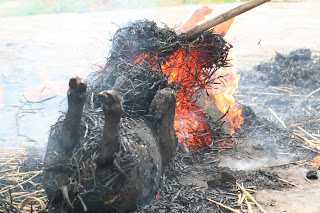
I spent my day off this week in the city of Bhaktapur. Bhaktapur is located just east of Kathmandu proper along an old highway that is being expanded to accommodate four lanes. The town is full of Newari temples, pallaces, and an endless amount of small alleyways. In one of the outlaying squares I stumbled upon a family roasting two pigs for sale to a hotel in Kathmandu.

Bhaktapur (~15 km east of Kathmandu). An classic Newari city of about 60,000 people.

A team of men loading massive 40 foot logs into a truck for transport.

It's a family affair.

Two family members prod, poke, and fan the fire.

Moving around the grasses that were used to cook the pig.

Washing the charred skin off of the pig.

Waste disposal. The majority of the innards were thrown into the river flowing just out of view.

The finished products.

The pigs are loaded for transport to a hotel and restaurant in Kathmandu.

Sunday, September 26, 2010

Indra Jatra

Kumari, the living Nepali goddess, is paraded around a square in Southern Kathmandu during the Indra Jatra festival. This festival marks the end of the monsoon season, although it did rain that night...

Hundreds of people gathered to see the Kumari.


Orientation

The five other ETA’s (English Teaching Assistants) and I have spent the last two weeks at the United States Educational Foundation-Nepal (USEF-Nepal). USEF offers free counseling and information (‘accurate, reliable, and unbiased’ information) about gaining admission to schools in the United States. Our mornings have been full of lessons on Nepali classroom etiquette, what it’s like to teach in the Nepali government system, and how to properly drink tea at all hours of the day. Afternoons have been packed with intensive Nepali language sessions. Some other highlights include visits to classrooms crowded with 60 students and a safety briefing at the US Embassy where we found condoms in the bathroom that were ‘From the American People.’ We have been working hard in our classes but we have focusing most of our energy on getting into sync with Nepali ways and getting usedto living in Nepali homes with Nepali families.
USEF-Nepal, Gyaneshwor, Kathmandu

Nepali culture dictates, like many in other South East Asian countries, that one eats food with only their right hand. The forfeit of my fork and concentration on my right hand is something I am only slowly getting used to. Although my fingernails (and sometimes forearms) are coated with small food particles and grease after my attempts to politely shovel dahl bhaht (rice and lentils) into my mouth it seems that because of the use of the hand, Nepalis are very conscience of the cleanliness of their hands both before and after eating a meal. I am constantly being told to wash my hands. My homestay mom’s belief, instilled by her grandfather, is that food cooked from the heart is the only food that tastes good. As an extension, food eaten with hands is the only food that is truly enjoyed. And the food has been superb!

I am staying with a family of Thakali descent who hail from the mountainous Mustang district, which is about 100km Northwest of Kathmandu near the border with Tibet. The Thakali are known for their cuisine, specifically their many varieties of dahl and the extensive use of beans. My particular family’s relatives operate an apple orchard in the hills and produce apple brandy (I have yet to try it but if the brandy is anywhere near the deliciousness of the apples themselves I am in for a treat). In Kathmandu, my family owns and operates an exceptional Thakali inspired restaurant.

Some of the many varieties of lentil.

My parents (Mana and Nirjhar) met through an arranged marriage 23 years ago and have two sons. The younger of the two children attends the English language boarding school, St. Xavier’s, on the other side of Kathmandu (where both Nirjhar and the eldest son, Arohan, attended) so I have yet to meet him. Arohan, my younger brother, who is 20 years old, is starting his undergraduate studies in hotel management this week. He made the interesting decision of staying in Nepal to study (versus going to India, Europe, or the US) because outside of Nepal he would have had to work alongside his studies. The next few years of his life would be better in Nepal. As a result of his education at St. Xavier’s, Arohan’s English language skills significantly outweigh his Nepali language abilities. So, you have a 20 year old who can only count to 27 in Nepali but speaks nearly flawless English. This trend among the more well off Nepalese (those that can afford private English language-based education) explains why Nepal sent more than 10,000 students to American universities last year (the 9th largest sending country).

Juxtaposed with an English speaking Nepali family is Jay. Jay is the boy who works for the family preparing food and cleaning the home. He was orphaned at a young age and through family connections my homestay mom now feeds, clothes, puts a roof over his head, and sends him to school in exchange for his work. He works very hard around the house but also puts an impressive amount of energy into struggling through his difficult grade 7 English textbook. We worked together last night on his exercises. The two of us sat on the floor of my room under the fluorescent light provided by a back up battery. Every evening between about 6 and 10 there are two or so hours where the government rations the electricity. The length of power cuts varies throughout the year being the most extreme (about 16 hours per day without power) in early spring when reservoirs are low. Days when the power cuts are short, my homestay mom jokes that the technician in charge of the area must have forgotten to shut off the power earlier and is now just trying to get back onto schedule. While sitting on the floor with Joy it didn’t take much imagination to think how amazingly challenging it must be for low income families to cope with life without electricity.

Jay working on science homework during a power cut.

Nepal is heavily reliant on hydropower and as a result of under investment over the past two decades due to the civil war there are severe shortages of electricity supply. Nepalis joke (only half heartedly) under candlelight during electricity cuts that the Indians have taken their electricity. They are only half wrong. Due to tariff discrepancies and demand economics, Nepali hydropower producers can sometimes make more money by exporting power to Northern Indian rather than putting it into the domestic grid.

Despite the less than adequate job the Nepali government has done to reduce poverty and bring reliable services to its people, the Nepalese are a superbly cheerful and fun group of people. My homestay mom had a good rice-spewing laugh today when I complimented her great ability to cook dog (an easy mix up with chicken being kukhurah and dog being kukhur). After two weeks of Nepali class I am bumbling my way through the language (bhahsah) but find motivation in the excited surprise that exudes from people when I try to speak. I’ll keep trying…

Monday, September 20, 2010

First Week

Kathmandu (3 photos stitched together).

Some of the thousands of prayer flags at one of the complexes at Swayambhunath in Kathmandu.

Prayer flags leading up to Swayambhunath in Kathmandu.

Prayer wheels in motion at Swayambhunath in Kathmandu.

Kathmandu from ground level. Although there is trash collection, garbage accumulates in and around the rivers. Older residents speak about how 30 years ago they used to drink straight from these now polluted rivers.

Kathmandu from above.

Two men find a dry place to huddle away from the rain for a few minutes near Durbar Square.

The start to rush hour traffic. Roads become gridlocked with cars, vans, trucks, safa tempos, and cows for a few hours in the mornings and afternoons.


Saturday, September 18, 2010

Kathmandu by Night

Some nights scenes from Kathmandu.

A fruit shop in Thamel.


Lazimpat Road.