Wednesday, June 1, 2011

From the Chicken Coop to the Granery: My New Bedroom

After having vicious allergies to my last room (the former chicken coop) I upgraded to a new room (the current grain storage facility).  You'd be surprised how comfortable a pile of rice can be.


Monday, May 16, 2011

Trapped in the Terai

Having some time on our hands, a few friends and I took a trip to the southwest corner of the country and made our way slowly to Bardia National Park where we wandered through the wilderness looking for and then escaping from large wild animals.  Much of the terrain looked like the land does in the two following images.  

The view from the top of a lookout tower.

We posted up at this spot for a few hours and scanned for birds and other wildlife.  I took a nap.

Bardia National Park (NP) is located northwest of Nepalganj (image source).
Nepal is made up of three very different geographic regions: 1) Terai, 2) Hill, and 3) Mountain.   Kathmandu is located in the hilly region.  In the south bordering India is the Terai region (see the map).  Being further south and about 4000 feet lower in elevation than Kathmandu, the cities in the Terai are dry, dusty, and unpleasantly warm.  This area is culturally influenced by India and shares the same climate as the massive Indian Plains.  In addition, the land is flat so large-scale rice paddy farming that is prohibited by the hills and mountains further north is possible here. 

The three main geographic regions or belts of Nepal: Terai, Hills, and Mountains (image source)
A satellite image highlighting Nepal's diverse geography (image source).
Another way to look at the elevation change across Nepal (from south to north) (image source).

Our fantastic guide.

A wild elephant.


The Tharu people are the dominant ethnicity around Bardia and in much of the Terai.  They have an interesting mix of Nepali and Indian blood and and are said to be direct descendants of Lord Buddha.  Life looks a bit different for people in the Terai with mud walled homes and lots of forestry products.

A row of Tharu houses.

People bike everywhere on Indian made bikes.

Whole days are committed to cutting through these trees in order to make door and window frames.
Some more woodworking.
On our second day in Bardia we found out there was a bandha (or strike) and we would be unable to leave.   People who participate in the strikes are known to drink heavily and there are numerous stories of vehicles being torched for breaking the rules of the strike.  After getting confirmation from a few other sources we found out that indeed there would be a bandha of unknown length.  These strikes can last a day or can be extended up to two weeks.  This particular bandha was organized and implemented by political parties in the region wanting more autonomy from the federal government.  Bardia was nice but we didn't want to spend two weeks there.  Our options were to wait it out (for however long or short the strike would last) or to ride bicycles the few hundred kilometers to the nearest operating bus stop.  We went so far as to visit some bike shops but lucked out with the strike only lasting two days.


A very old birth control billboard along the road near Bardia.


Weed grows wild in the fields.  Travelers are advised to wash boots before heading back to the airports.

We spent a great afternoon during the bandha (the stirke) at the local swimming hole.

Wednesday, April 13, 2011

Don't Insist on English!

Check out this new TED talk by Patricia Ryan who has spent the last 40 years teaching English in the Arabian Gulf.  More on Patricia Ryan.

"At TEDxDubai, longtime English teacher Patricia Ryan asks a provocative question: Is the world's focus on English preventing the spread of great ideas in other languages? (For instance: what if Einstein had to pass the TOEFL?) It's a passionate defense of translating and sharing ideas."


Tuesday, April 12, 2011

The Nepali Brick Industry

Kathmandu was a stronghold of the national government during the civil war of the late 90's and early 2000's.  Because the Valley was significantly safer than outlying areas many people moved for security reasons.  The population of the Kathmandu Valley has, according to some estimates, doubled in the past 20 years (from 2 to 4 million).  A consequence of this population growth is an ongoing boom in residential construction.  Many of the buildings in urban and semi-urban Nepal are built predominantly of brick.  Much of the Valley's bricks come from Lalitpur district, which lies just south of Kathmandu proper, and happens to be where I live with my family. 


The fields surrounding my village are strewn with brick factory smoke stacks such as this one.  
Bricks are made by mixing water with the top couple meters of soil and clay from fields.
A close up of the bricks in a stack as they dry.  Notice the swastika imprinted on the bricks.  In Hindu culture, the swastika is an auspicious symbol (http://en.wikipedia.org/wiki/Swastika).

After bricks are formed they are piled up to dry.

People carry amazingly heavy loads of bricks on their backs.

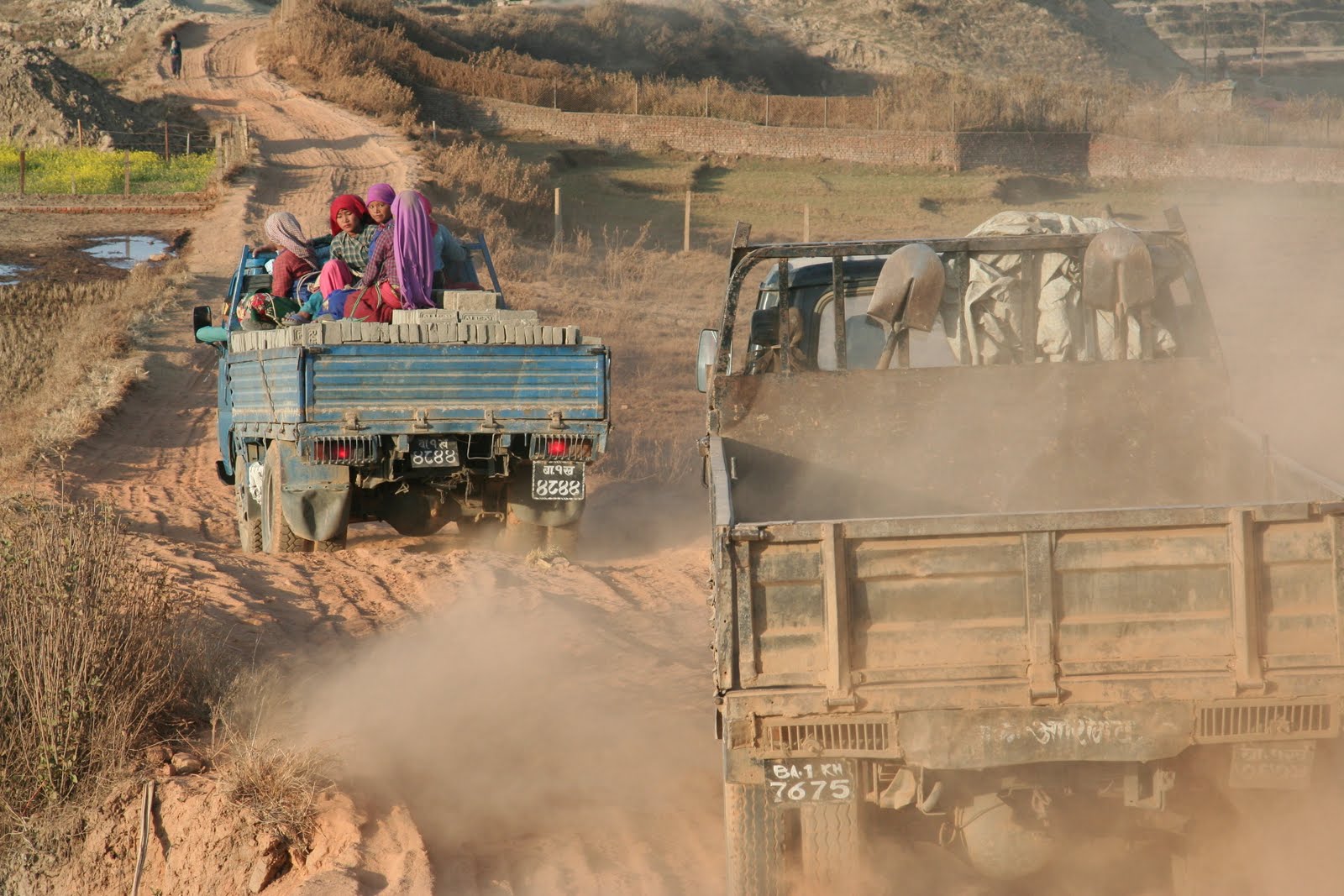
Stacking bricks in a truck for transport.

Bricks are moved to construction sites.

A view of Kathmandu proper over a pile of drying bricks.  The brick structure on the left is a temporary home constructed by migrant workers.
Another Fulbright grantee, Taylor Weidman, has some outstanding shots (click here) from a nearby brick kiln.

Tribhuvan University: The Gem of Nepali Higher Education

Tribhuvan University (TU), established in 1959, is the oldest university in Nepal.  Including its many affiliates TU has a student body of about 300,000 students.  The University has an impressive offering of different courses and programs.  I visited the main campus in Kathmandu to check out the campus life. 

Students sitting on top of some academic building.  The combination of roaming students, scorched ground, and trash piles reminded me of a fraternity house on a spring afternoon.

The volleyball match between the Library Science and Education departments was well attended.

Students watch the match.

Nyaya Health Country Director Position Available

An interesting job posting in public health in Nepal.
Job Posting


About NyayaNyaya Health operates a hospital and mobile medical care services in Achham, a large district in Nepal. Achham is one of the poorest regions in South Asia, and shoulders some of the world’s highest mortality rates, particularly among women. Following a decade-long civil conflict, the health infrastructure of the region has been ravaged. Nyaya provides essential primary care to the region, as requested and directed by community members. We work in partnership with local government officials as part of an initiative to rebuild the public sector health system. We construct healthcare infrastructure, train local health workers, and provide direct medical services. Our organization employs an all-Nepali staff with supervision and training from volunteer public health experts. We maintain an “open source” approach involving complete transparency in our expenditures, operations protocols, and clinical outcomes, which are detailed on this website.

About the position: The Country Director (CD) plays a critical role in the administration of the organization through the oversight of Nyaya’s work in Nepal. The CD will work full-time in Achham and coordinate closely with Nyaya team members in Kathmandu and outside of Nepal, helping to manage and respond to daily operational needs of the organization. This position will include elements of team management, strategic planning, program management and research coordination, as well as support for critical development, networking and fundraising activities. The role requires a commitment to social justice work and an excitement to work in a dynamic and challenging personal and professional environment.

Keeping Girls in School

The Asia Society is hosting an event in Washington, DC to discuss the topic of "Keeping Girls in School." From the Asia Society Website:


"The issue of gender-based educational rights remains a challenge for many Asian countries, particularly in rural areas. There are many reasons why girls have no access to basic education or drop out from schools. These include economic considerations, gender bias, safety, lack of adequate school facilities within their neighborhoods, and absence of female role models in schools.  Girls' education is vital to a country's development because it promotes investment in human resources and is capable of raising living standards and encouraging social stability if managed well." 

This topic is germane to Nepal's educational system.  At my school, which is semi-rural, about 70% of the students are girls.  In Nepal there is a huge private school industry where the private schools' main difference from public schools is the use of English as the sole medium for teaching.   A good English background is a top educational objective for many families. So, if families have enough money to afford private school they will choose to send a boy leaving the girls to go to the public schools.  Granted there are lots of boys and girls who do not attend school at all, this sexual bias creates an interesting dynamic in the classroom and school.